












By Bella Stryker
Hemlines will not be traveling north this summer. If anything, they’ve packed a suitcase and headed south.
Jorts, the longline denim shorts that fall at or just below the knee, have officially shed their ironic undertone. Once suburban, skater-coded or aggressively dad-adjacent, they now seem… Deliberate, editorial and even polished. Love them or hate them, jorts are certainly not quietly retreating into the denim drawer.
The modern jort rejects the tight, mid-thigh “festival short” in favor of length, volume and structure. Cut from rigid cotton denim in a classic twill weave, today’s versions hold their shape. The heavier textile resists cling and creates a boxy, column-like silhouette that feels more architectural than distressed. These are not the frayed cutoffs of the 2010s. They are cleaner, darker, sharper. In other words: less Coachella and more Copenhagen.
The shift may seem subtle — until you consider how abbreviated the past few summers have been. Micro-mini skirts, low-rise waistlines and visible hip bones dominated the post-pandemic exuberance cycle. Now the volume has redistributed. Coverage has increased. The knee has reentered the conversation.
The data supports the shift. According to Pinterest Trends Predictive Forecasting (United States, past two years), search interest for “jorts” is projected to reach an index value of 74 for the week ending May 15, 2026, with a predicted range between 55 and 100. (Pinterest indexes search volume from 0 to 100, reflecting how often a keyword is searched compared to all keyword searches that week.) In other words, relative interest is not plateauing—it is climbing into peak summer territory.
More telling is the adjacent movement. Searches for “bermuda shorts” are forecasted at an index of 71 for that same week, while “capris” recently reached a full 100 index point earlier this year, signaling maximum relative search popularity (Pinterest Trends Predictive Forecasting). If jorts were simply a fleeting micro-trend, adjacent longer-hem silhouettes would not be rising in tandem. Instead, the data suggests something broader: the elongated hemline itself is gaining momentum.
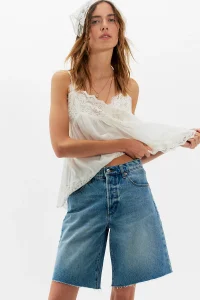
Retail has responded accordingly. Levi’s, Free People, American Eagle and Reformation have all embraced knee-length denim cuts, moving the silhouette firmly into mass-market circulation. At the same time, the runway has offered reinforcement. In the Spring/Summer 2026 season, houses including Balenciaga, Prada and Patou incorporated structured denim Bermuda silhouettes into their collections. While not always labeled explicitly as “jorts,” the elongated proportions reflect the same hemline trajectory. The difference is refinement—cleaner cuts, darker washes and sharper finishes that reposition the look as intentional rather than ironic.
Culturally, the revival owes much to the rise of the “model-off-duty” aesthetic.
Celebrities like Hailey Bieber, Kendall Jenner and the Hadid sisters reframed knee-length denim as polished rather than awkward, styling it with minimalist tanks, oversized blazers, sleek flats and narrow sunglasses. Paparazzi images circulated on Instagram. TikTok recreated the outfits. Pinterest indexed the searches. What once felt suburban became aspirational — because it was styled that way. Social media did not invent jorts, but it did rehabilitate them.
The silhouette also sits within a broader economic recalibration. The so-called “Hemline Index”—the theory that hemlines lengthen during periods of economic caution—may not be scientifically definitive (Nasdaq), but its cultural resonance remains. In an era marked by inflation, housing instability and cautious consumer spending, fashion has leaned toward practicality and longevity. Longer shorts feel more wearable, more versatile, more defensible as an investment. They communicate restraint rather than excess.
Still, the jort as we know it may not be the final destination. The longer hemline it introduced is already evolving into tailored Bermuda shorts, structured trouser shorts and even capris. The cultural appetite appears less concerned with the specific garment and more invested in the direction of the hem.
Jorts may not dominate indefinitely. But their message is clear: the era of longer hemlines is back. And whether the credit goes to macroeconomics, algorithms or a well-timed paparazzi stroll in Manhattan, the numbers suggest that hemlines are settling south—and they seem perfectly comfortable there.
Looking to add jorts to your collection? Check out some of our personal faves here.
This article may contain affiliate links. If you make a purchase through these links, SMU LOOK may earn a small commission at no additional cost to you. These commissions help support our student publication and allow us to continue creating content for our community.