















By Mythili Reddibathini
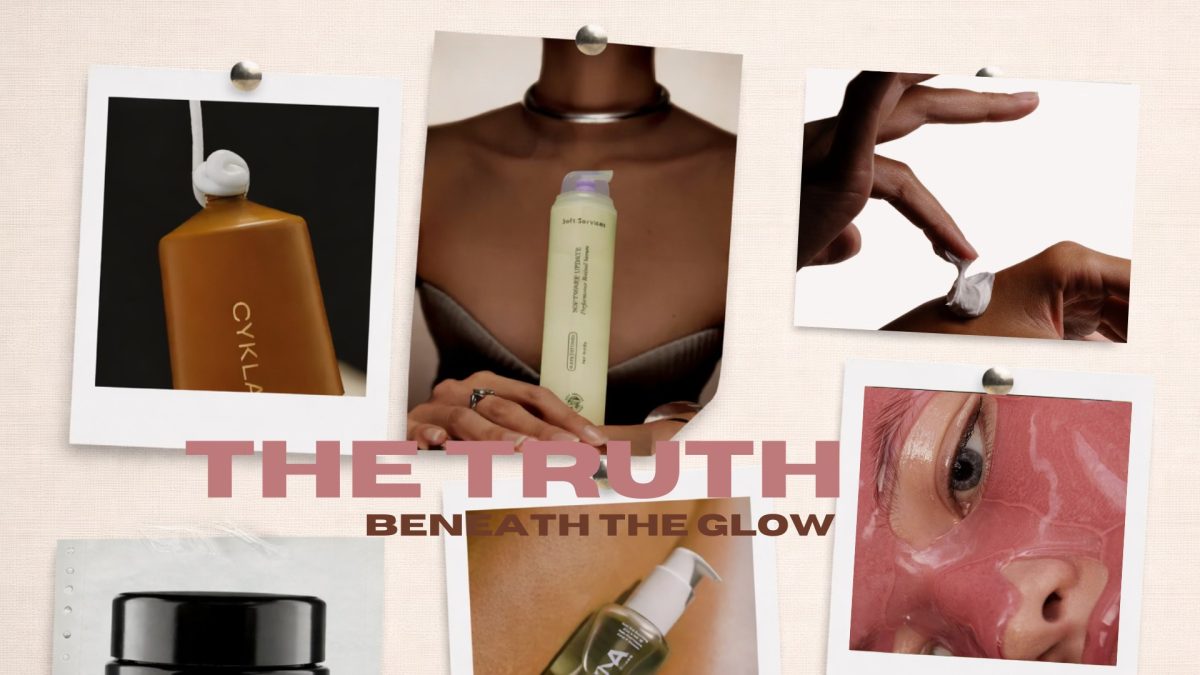
Walk into any Sephora or open TikTok, and you’ll be met with a wall of serums, each with louder messaging than the last: “fully natural,” “clean beauty,” “free from synthetics.” The language of skin care has shifted from “What does this do for my face?” to “What do the products I use say about me?” Somewhere between Drunk Elephant hauls and the rise of skin cycling, skin care stopped being personal and became a way for consumers to signal what they believe in.
The clean beauty movement exploded in the 2010s and gained even more traction in the 2020s. Consumers were encouraged to buy into a specific aesthetic centered on a more natural look, to fear ingredients they couldn’t pronounce and to equate “natural” with “safe.” The result: a booming industry of products that lead with ethos over efficacy. Brands know phrases like “botanically derived” sell. “Synthetically formulated for optimal skin barrier repair” doesn’t have the same appeal, even if it may be more effective.
The irony is that the natural-versus-synthetic debate is largely a marketing construct. Many dermatologists agree. In a study conducted by Stanford Medicine researchers, dermatologist Dr. Gordon Bae and medical student Haiwen Gui examined 1,700 “natural” skin care products for allergens. More than 94% contained at least one known contact allergen, and 90% included an ingredient ranked among the top 100 most clinically prevalent allergens.
In an Allure article, California-based dermatologist Dr. David Kim said, “It’s inaccurate to assume that everything chemical is bad, and everything natural is good. I often tell my patients that poison ivy is natural, but that’s not something you want to put on your skin. Ever.”
Even the term “chemical-free” is misleading. Everything, including water, is a chemical.
Still, knowing that “natural” doesn’t always mean better doesn’t stop consumers from buying in. Skin care has become a form of self-expression. The Ordinary made minimalist, clinical aesthetics aspirational. Rhode turned its peptide lip treatment — complete with a phone case holder — into a status symbol. Skin care shelves have become mood boards.
At SMU, where beauty and wellness trends often spread quickly, the trend is hard to miss. IV drips after a night out and red light face masks have become increasingly visible in student beauty and wellness routines. These practices aren’t inherently harmful, but constantly adding new products can make consistency difficult. So why do so many people continue to follow these trends?
At a recent Nude by Nature U.S. launch, I spoke with Clint, a professional makeup artist who has worked with the Australian brand for 16 years. He said the brand was created to fill a gap: Many consumers’ purchases don’t align with their ethical values around sustainability and regulation. He acknowledged that natural makeup hasn’t always met the same standards as conventional products.
Nude by Nature addresses this tension — the desire for products that feel both effective and authentic. Built on mineral-based, naturally derived formulas, the brand promotes the idea that what’s good for your skin should also feel good ethically and aesthetically. According to Clint, “If you wouldn’t put it in a salad, don’t put it on your skin or lips.”
I tested the brand’s foundation, powder and blush at the launch and was impressed by how they performed compared with more expensive products. In my opinion, this was proof natural brands have improved significantly and can now compete with established favorites.
Still, the science is clear: Natural ingredients aren’t automatically superior. Some of the most effective actives — including retinoids, niacinamide and hyaluronic acid — are synthesized for precision and consistency. Botanical extracts can vary from batch to batch, meaning a product may perform differently over time. Meanwhile, natural irritants such as essential oils and plant fragrances are among the most common causes of allergic reactions.
So why does the natural-versus-synthetic divide persist? Because it’s no longer just about skin care. It’s about identity. Choosing “clean” beauty is, for many, a value statement — an alignment with sustainability, wellness culture and a curated sense of simplicity.
There’s nothing wrong with that. But consumers should understand what’s actually in the products they use on their skin — the body’s largest organ — every day.
The best skin care routine has always been the one that works for you, not someone else. Whether it’s a drugstore product or a luxury serum, education and honest messaging are what truly matter.
Editor’s note: The writer attended a Nude by Nature launch event and tested products provided by the brand.